राष्ट्रिय पात्रो  •  The National Calendar

Nepal Sambat नेपाल सम्बत

The ancient lunar calendar of Nepal — the only calendar in the world named after a nation, not a ruler. Initiated in 879 AD by the merchant-philanthropist Sankhadhar Sakhwa, who freed all Nepalese people from debt.

Scroll
नेपाल
About

Nepal Sambat

नेपाल सम्बत

Nepal Sambat is the official lunar calendar of Nepal — formally recognized as the national calendar in 2007 AD. It holds a singular distinction in world history: it is the only calendar named after a country, not a ruler or religious leader.

A lunisolar calendar of 354-378 days per year, with an intercalary month added every third year, it was in continuous official use for 890 years — from 879 to 1769 AD. Even after its official replacement, it never ceased being the heartbeat of Newari cultural life.

Today, nearly all major Newari festivals — from Indra Jatra to Mha Puja — are observed according to its ancient reckoning. Major Nepali newspapers publish dates simultaneously in all three calendars: Gregorian, Bikram Sambat, and Nepal Sambat.

Founded 879 AD Lunar Calendar 354-378 Days/Year 890 Years Official Use National Calendar 2007
Read More →
✦ ॐ ✦
Lunar Panchang

Nepal Sambat Multicultural Calendar नेपाल संवत् बहुसांस्कृतिक पात्रो

Discover the sacred months and days of the Nepal Sambat lunar calendar. Select any date to explore its Nepal Sambat and Panchang.

© Nepali Calendar — Powered by ashesh.com.np
❖ ᥊ ❖
Through the Ages

History of Nepal Sambat नेपाल सम्बतको इतिहास

A journey through 1100+ years of continuous cultural heritage

879 AD
The Founding of Nepal Sambat

Sankhadhar Sakhwa, a Newari merchant, clears all debts of the Nepalese people using gold panned from the Bishnumati river. A new calendar era is proclaimed during the reign of King Raghabdev to commemorate this extraordinary act.

908–920 AD
Earliest Written Records

Palm-leaf manuscripts dated N.S. 28 and N.S. 40 appear in Nepalese collections. Medieval stone inscriptions begin using Nepal Samvat as the primary dating system, establishing it as the authoritative calendar of the valley.

1028 AD
Named Nepal Vatsara

The calendar is officially named "Nepal Vatsara" in N.S. 148 — the first time this name appears in written record. It becomes the definitive standard for legal, royal, and religious documents throughout the Malla kingdoms.

1769 AD
Discontinued Under Shah Rule

After Prithvi Narayan Shah conquers the Kathmandu Valley, official use of Nepal Sambat is discontinued and replaced by Shaka Sambat. Despite this, the calendar continues to be observed culturally by the Newar community for centuries.

1999 AD
National Hero Recognition

The government declares Sankhadhar Sakhwa a national hero on November 18, 1999 — a landmark victory for the Nepal Sambat movement and formal acknowledgment of his foundational role in Nepali cultural history.

2007 AD
National Calendar Reinstated

The Government of Nepal formally recognizes Nepal Sambat as the national calendar, restoring its official status after 238 years. Newspapers now publish all three calendars side by side: Gregorian, Bikram Sambat, and Nepal Sambat.

✦ ☸ ✦
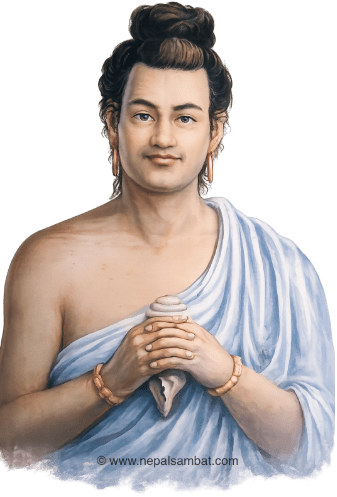
Sankhadhar Sakhwa

Sankhadhar Sakhwa

संखधर साख्वा
National Hero

The Merchant Who Freed a Nation

"He paid the debts of every soul in Nepal"
A merchant of Kathmandu named Sankhadhar Sakhwa panned gold from the sands of the Bishnumati river, and with this wealth, freed every subject of Nepal from their debts to the crown.

Sankhadhar Sakhwa was a Newari merchant whose extraordinary act of philanthropy changed the course of Nepali history. According to the historical manuscripts Bhasa Bamsali and Rajbhogmala Bamsawali, this common merchant freed the entire population of Kathmandu from their financial obligations to the state.

To honor this remarkable event, King Raghav Dev proclaimed a new calendar era — Nepal Sambat — beginning from the date of the great debt clearance in 879 AD. Sakhwa's legacy endures in his stone image at the southern gate of the sacred Pashupatinath Temple.

Read Full Story →

Mha Puja — The New Yearम्ह पूजा

The sacred New Year's Day of Nepal Sambat, Mha Puja is a profound Newari ritual of self-worship — a celebration of life, renewal, and the divine within. Families gather to perform puja for themselves, beginning each new Nepal Sambat year with grace and spiritual intention.

Learn about Mha Puja →
Cultural Tapestry

Cultural Highlights सांस्कृतिक विशेषताहरू

Explore the rich festivals, traditions, and heritage woven into the Nepal Sambat calendar

🌕

Lunar Cycles

चन्द्र पञ्चाङ्ग

Nepal Sambat is a lunisolar calendar of 354 days, synchronized with the moon's phases. An intercalary month is added every third year to realign with solar cycles, keeping festivals seasonally accurate across the centuries.

Explore months →
🏛️

Newari Festivals

नेवारी चाडपर्व

Nearly all major Newari festivals — Indra Jatra, Bisket Jatra, Gai Jatra, Kumari Puja — are scheduled according to Nepal Sambat. It remains the living heartbeat of Newari cultural and spiritual life in the Kathmandu Valley.

Learn more →
📜

Historical Manuscripts

ऐतिहासिक लिपि

Thousands of palm-leaf manuscripts, stone inscriptions, and royal charters from Nepal are dated in Nepal Sambat — making it an indispensable key for scholars studying the medieval Malla kingdoms and their rich heritage.

View history →
🗞️

Modern Newspapers

समाचार पत्र

Major Nepali newspapers today publish dates simultaneously in Gregorian, Bikram Sambat, and Nepal Sambat — a living testimony to its continued relevance and official standing in contemporary Nepalese society.

Read history →
🏺

Paubha Art

पौभा चित्रकला

Traditional Newari Paubha painting — intricate sacred artworks depicting deities and mandalas — has flourished throughout the Nepal Sambat era, encoding cosmological wisdom in pigment on cloth and copper foil.

Explore culture →
⚖️

Legal Recognition

कानूनी मान्यता

Since its reinstatement in 2007, Nepal Sambat holds official national status alongside Bikram Sambat — reflecting Nepal's commitment to honoring indigenous Newari heritage within its modern constitutional identity.

Full history →